
- info@minnexon.com
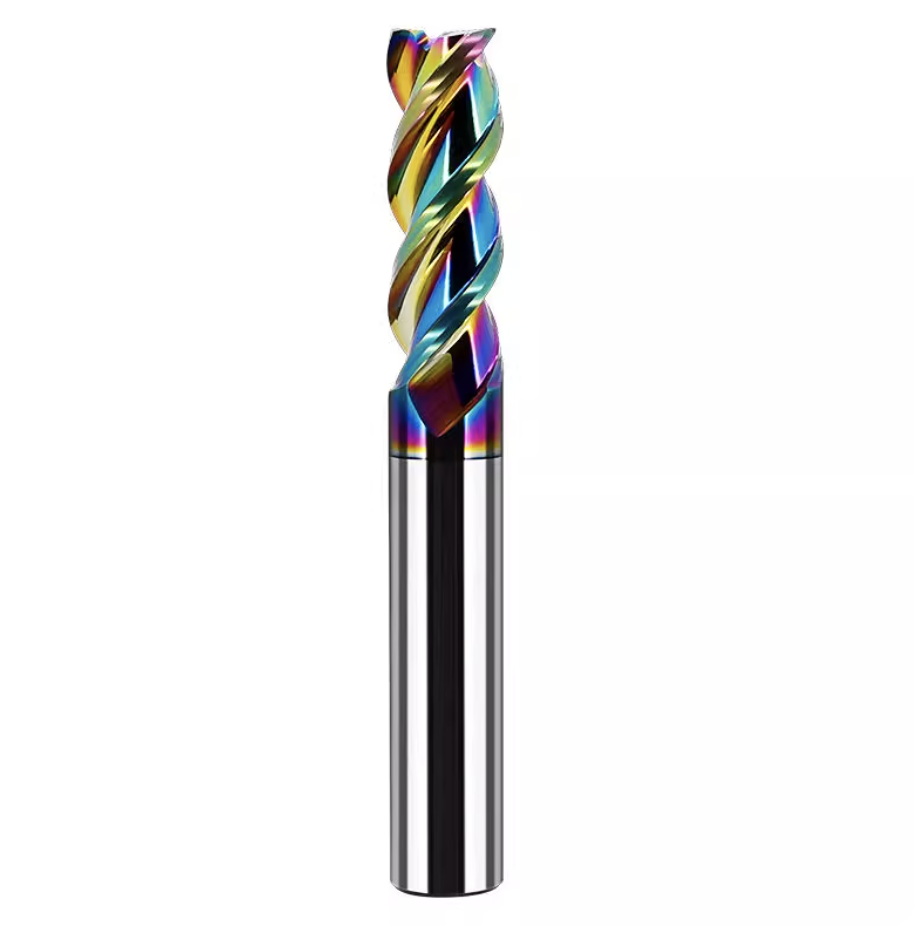
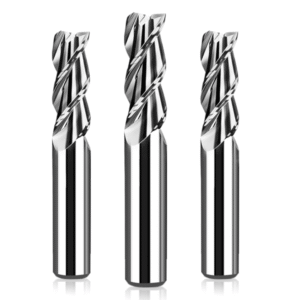
Aurora Series: Rainbow DLC Coated End Mills for High-Silicon Aluminum
Experience next-level durability with our Rainbow (ta-C) coated end mills.
Ultra-low friction coefficient (<0.1) and extreme hardness for abrasive aluminum and aerospace alloys.
The Aurora Series: Precision Meets Extreme Durability
Standard uncoated carbide is excellent for general aluminum work, but when you are facing long production runs or abrasive materials, you need armor.
Introducing the Aurora Series. These tools feature a specialized Tetrahedral Amorphous Carbon (ta-C) coating—often recognized by its distinctive rainbow or multicolored hue. This isn’t just for aesthetics; it is a functional, high-performance shield that creates the ultimate non-stick surface for machining non-ferrous materials.
The “Rainbow” Advantage: Why Coating Matters
While standard tools rely on sharpness alone, the Aurora Series relies on lubricity and hardness.
Near-Zero Friction: The rainbow coating offers a coefficient of friction as low as 0.05. This makes the tool surface slipperier than Teflon. Chips glide off instantly, virtually eliminating the risk of chip welding (BUE), even when machining “sticky” alloys like 6061-T6.
Diamond-Like Hardness: With a surface hardness reaching HV 5000+, this coating is significantly harder than standard carbide. This makes it the perfect choice for High-Silicon Aluminum (often used in automotive pistons and castings), which typically acts like sandpaper on uncoated tools.
Dry Machining Capable: Thanks to the extreme thermal stability and lubricity of the coating, these tools perform exceptionally well in Minimum Quantity Lubrication (MQL) or even dry machining environments where coolant usage is restricted.
Technical Specifications
| SIZE | CUTTER DIA./mm | LOC/mm | SHANK DIA./mm | OAL/mm | FLUTES |
|---|---|---|---|---|---|
| D1*50L | D1 | 3 | 4 | 50 | 3 |
| D1.5*50L | D1.5 | 4.5 | 4 | 50 | 3 |
| D2*50L | D2 | 6 | 4 | 50 | 3 |
| D2.5*50L | D2.5 | 7.5 | 4 | 50 | 3 |
| D3*50L | D3 | 9 | 4 | 50 | 3 |
| D3*75L | D3 | 12 | 4 | 75 | 3 |
| D3*100L | D3 | 12 | 4 | 100 | 3 |
| D4*50L | D4 | 12 | 4 | 50 | 3 |
| D4*75L | D4 | 16 | 4 | 75 | 3 |
| D4*100L | D4 | 20 | 4 | 100 | 3 |
| D5*50L | D5 | 15 | 5 | 50 | 3 |
| D5*75L | D5 | 20 | 5 | 75 | 3 |
| D5*100L | D5 | 25 | 5 | 100 | 3 |
| D6*50L | D6 | 18 | 6 | 50 | 3 |
| D6*75L | D6 | 25 | 6 | 75 | 3 |
| D6*100L | D6 | 30 | 6 | 100 | 3 |
| D8*60L | D8 | 24 | 8 | 60 | 3 |
| D8*75L | D8 | 30 | 8 | 75 | 3 |
| D8*100L | D8 | 35 | 8 | 100 | 3 |
| D10*75L | D10 | 30 | 10 | 75 | 3 |
| D10*100L | D10 | 40 | 10 | 100 | 3 |
| D12*75L | D12 | 36 | 12 | 75 | 3 |
| D12*100L | D12 | 45 | 12 | 100 | 3 |
| D14*100L | D14 | 45 | 14 | 100 | 3 |
| D16*100L | D16 | 45 | 16 | 100 | 3 |
Target Applications
The Aurora Series is over-engineered for simple hobbyist work; it is designed for demanding industrial sectors:
3C Industry (Electronics): Precision casing for smartphones and laptops where surface finish is critical and tool changes must be minimized.
Aerospace Components: Machining 7075 and 2024 alloys where maintaining tight tolerances over long cycle times is mandatory.
Automotive Castings: Handling abrasive cast aluminum with high silicon content.
Mold & Die: Copper electrode machining.
Frequently Asked Questions (FAQ)
Q: Is the rainbow color just for looks?
A: No. The iridescent “rainbow” effect is a natural byproduct of the thin-film refraction of the ta-C coating layer. It indicates a very specific, high-hardness hydrogen-free carbon structure. It serves as a visual wear indicator—as long as you see the color, the protective layer is intact.
Q: Can I use this on Steel or Stainless Steel?
A: No. Carbon-based coatings (like DLC/ta-C) will degrade rapidly if exposed to the high heat generated by machining ferrous metals (iron/steel). The carbon in the coating will diffuse into the iron, destroying the tool. Keep these tools strictly for non-ferrous materials.
Q: How much longer will this last compared to a bright finish (uncoated) tool?
A: In standard 6061 aluminum, you can expect 3x to 5x the tool life. In abrasive high-silicon aluminum, the difference is even greater, as uncoated carbide dulls rapidly in those conditions.
Q: Can I re-grind these tools?
A: Physically, yes, but we do not recommend it. Regrinding removes the specialized coating on the cutting edge, which defeats the purpose of buying the Aurora Series. For maximum performance, use them until the wear life ends and replace them.
Related products
-

TiAlSiN Nano Coated 4-Flute End Mills | Hard Milling up to HRC 65
Read more -
General Purpose TiAlN Coated 4-Flute End Mill | Best Value for Steel up to HRC 45
Read more -
4-Flute Solid Carbide End Mills | AlTiN Coated for Steel & Stainless | HRC 55
Read more -
3-Flute Solid Carbide End Mills for Aluminum
Read more
Get in Touch
We will provide you with feedback within 24 hours.